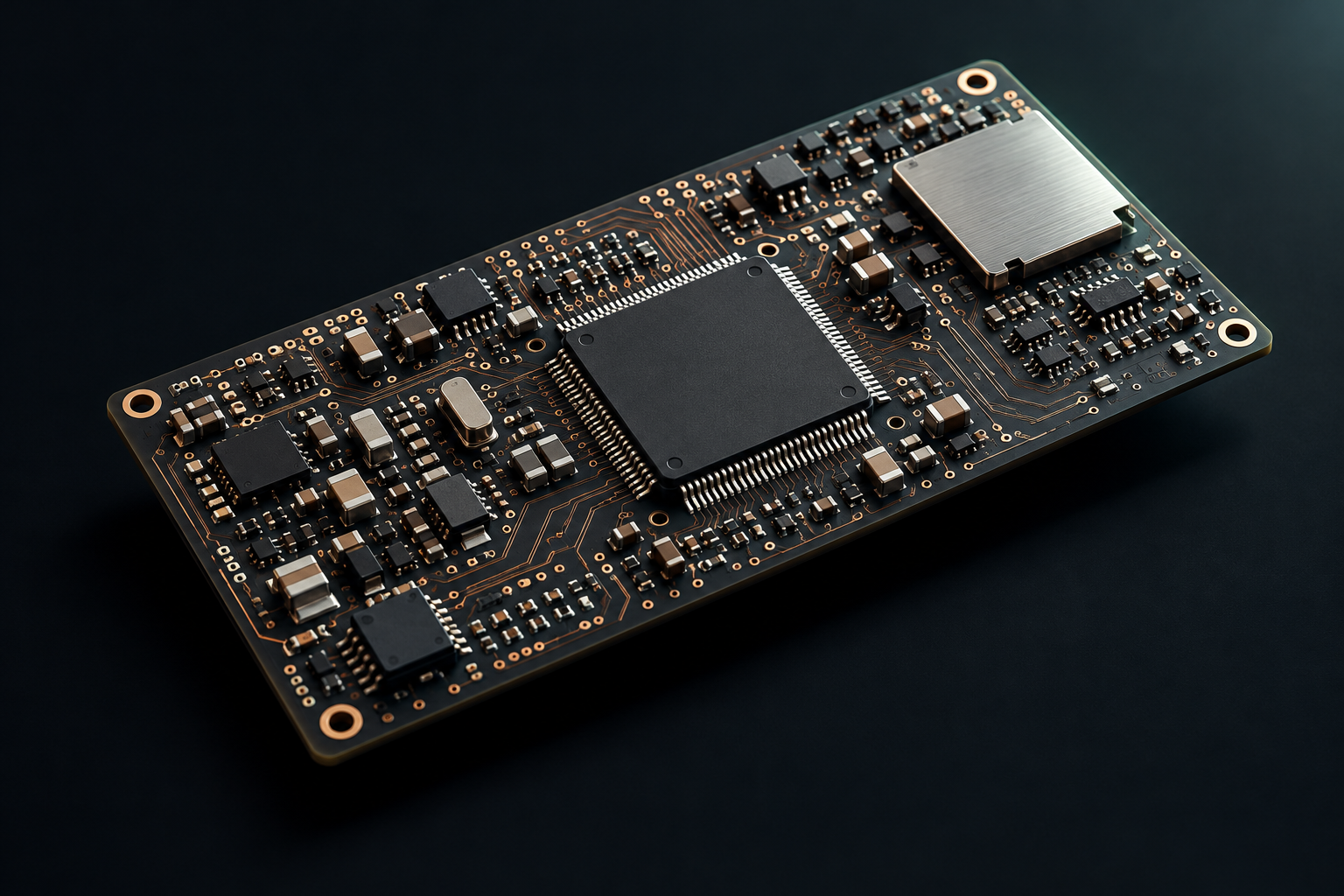
Electronic design, connected systems and practical AI. From the first concept to a working prototype, QED helps you bring the whole picture together.
You might have a new product in mind, equipment that needs a little more intelligence, or a technical problem that just won’t go away. Let’s work out what’s needed and build from there.
Start with your challenge. We’ll find the way forward.
You don’t need every part of the answer before you get in touch. QED can help with a specific piece of engineering or bring the hardware, firmware and software together into one considered design.
Electronics & embedded systems
Make your idea something you can test.
Good hardware starts with understanding what it needs to do. We work through the circuit, PCB layout and embedded firmware together, keeping practical details such as power, sensor interfaces and the enclosure in view.
Whether you’re starting with a sketch or improving an existing product, the aim is a prototype that gives you useful answers and a clear next step.
Getting a device online is only part of the job. The information it sends needs to be understandable, securely handled and useful to the people looking after it.
QED brings together device electronics, wireless or cellular communications and monitoring software, with thought given to commissioning, interrupted connections and fault finding.
There may be valuable answers in your technical documents, equipment logs and everyday processes. We can help you explore where AI could make that information easier to find, understand or work with.
Start with a focused pilot on infrastructure that suits your business. We’ll look at what’s feasible, how the results will be checked and whether the idea earns its place.
A sensor reading becomes useful when the right person can understand it and decide what to do next.
That means thinking beyond an individual circuit or a screen. How will the equipment be installed? What happens when a connection drops? What does someone need to see when they’re trying to solve a problem?
Explore the parts of a connected system below. This is an illustration of how QED approaches a design, rather than a live device feed.
Start with a trustworthy measurement.
The electronics and firmware need to suit the real environment: the sensor, power supply, timing and interfaces. A useful system starts by collecting information you can make sense of.
Plan for life outside the workshop.
Wireless coverage, reconnecting after an interruption and bringing a new device into service all matter. Connectivity works best when it’s designed alongside the equipment and the software.
Give the information some context.
A value needs a unit, a time and a clear explanation of where it came from. Monitoring screens and event history help people spot changes and investigate what happened.
A direct relationship
Talk to the engineer doing the work.
QED is an owner-operated UK consultancy. You work directly with someone who understands the circuit, the code and the system around them.
That makes it easier to ask questions, discuss a trade-off or change direction when a prototype teaches us something new. You get a practical conversation about your project, with the detail explained as clearly as possible.
The right design depends on how it will be used, what it needs to cost and what you need to prove. We’ll work through those constraints with you before adding complexity.
Useful progress you can see
Design reviews, working prototypes and measured results make decisions easier. You’ll know what has been explored, what has been learned and what still needs attention.
One connected perspective
Experience across electronics, embedded systems, connectivity and servers helps keep the interfaces between them in view, where small details can make a big difference.
Working together
A good conversation. Then a practical plan.
Some projects start with a detailed specification. Others start with “could we make this work?” Both are welcome. We’ll agree a sensible scope and build the evidence needed for your next decision.
Understand the problem
We begin with what you’re trying to achieve, the equipment or users involved, and the constraints that matter. From there, we can agree the architecture and the questions a prototype should answer.
Build, measure and refine
A design becomes more useful when it meets the real world. Hardware bring-up, firmware development and integration give us something to test, discuss and improve together.
Make the next step clear
We’ll agree the design files, software, test notes and handover your project needs. Further development and support can then be shaped around what you’ve learned and where you want to take it.
From microcontrollers and sensor interfaces to ARM/Linux systems, wireless communications, telemetry and local AI integration.
Your next engineering challenge
Something on your mind? Let’s work it through.
You don’t need a finished specification to start a conversation. Tell us what you’re hoping to achieve, what you’ve tried and where you could use a hand. We’ll talk through whether QED is the right fit and what a sensible next step might look like.
Our public pages work without cookies. We use no advertising or analytics cookies.
Accept essential lets us remember this choice for 90 days. A separate session cookie supports IoT sign-in and secure forms when you use them.
What won’t work with no cookies?
IoT sign-in, dashboard access and secure online enquiry forms need a session cookie. Choosing No cookies also signs you out of any current IoT session. You can still browse our services and email us.
We won’t save a “no cookies” preference, so this panel may appear again on another page. Animation controls still work on the current page.